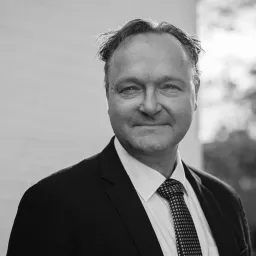
Interview with Morten Karsdal, CEO of Nordic Bioscience
Format: 17 Minute Interview
0:05
Good afternoon and a very warm welcome to today's interview with Morten Karsdal, CEO of Nordic Bioscience.
0:12
Thank you very much for joining us today.
0:14
Really appreciate your time.
0:16
So let's get started with the first question.
0:19
As CEO of Nordic Bioscience, can you please outline your role and how has your work in biomarker research influenced the strategic direction and priorities of Nordic Bioscience?
0:33
Thank you for that question.
0:35
So my journey started at Nordic 27 years ago, more than 750 publications ago.
0:45
And actually my first publication was incorporation of a cell into a 3D matrix.
0:51
And I saw how that cell changed shape, function and fate.
0:57
And then I got super interested in extracellular matrix.
1:00
But being brought up as an engineer, I was really interested in quantifying matrix protein and I was interested in making biomarkers.
1:11
Then later, it turns out that there's actually more than 70 different diseases, chronic diseases that all have extracellular matrix as a common denominator - that can be liver fibrosis, skin fibrosis and many other chronic diseases.
1:28
And so extracellular matrix is super important and it's a little bit difficult to quantify.
1:34
And so that's our unique niche at Nordic Bioscience and our research groups.
1:41
So we take advantage of the extracellular matrix and quantify that.
1:46
In serum in particular, we quantify specifically fragments of formation and degradation separately so we can see if it's fibrogenesis or the tissue destruction.
1:59
And that gives us a fantastic insight into what's ongoing in tissue.
2:05
Fantastic.
2:06
Thank you very much.
2:07
And so you've touched on my next question, which is what is your long-term vision for the role of ECM markers in transforming the diagnosis and treatment of chronic diseases?
2:22
So of course, I think it's a small disaster that you can go to your doctor and then you can have measured your cholesterol and your inflammation on a good day, something with the heart antipropium P But actually we're not catering to those 40% of patients that are that are dying from matrix related and fibroblast diseases.
2:45
And I think it's important that we enable that, that we put biomarkers on platforms that allows patients to have their matrix turnover assist because apparently that's the cause of the outcome from 40% of death in the Western world.
3:03
So that is essential.
3:04
And then if you elevate the question, what is my vision?
3:08
So, of course, I think that that my team is the best one in the world for looking quantitatively at the matrix.
3:16
And so we can use our biomarkers to find the patients, but we can also use similar antibodies to target the tissue.
3:24
We for example, can do this in solid tumours where we can find the patients that have a worse prognosis.
3:32
And then we can target the monoclonal antibodies to the tumour and help building antibody drug conjugates and radioligand.
3:39
And so that's a theranostic approach that we will be enabling the future.
3:43
So I think there are many ways matrix signs and tools and technologies can help patients.
3:51
Thank you very much.
3:53
What is the PRO-C3 assay? As a marker of active fibrogenesis, what makes this target particularly useful in assessing dynamic fibrotic activity compared to conventional methods?
4:07
Yeah, so that's also a good question.
4:12
So I think we all accept that any protein can have multiple important domains that can be a catalytic domain, that can be a binding domain.
4:23
But it seems to me that we do not respect that the quantification of that protein therefore is very important to do that correctly.
4:34
Are we targeting the formation peptide or a degradation of fragment?
4:39
And so normally when we start developing assays for a given protein, we try to develop 20 different assays and we find propeptide of carditin.
4:48
So we know it's tissue formation.
4:50
And then we have other fragments of type 3 carditin that are decoration fragments.
4:55
So we use monoclonal antibodies in a given way.
4:59
So we know that it's exactly tissue formation and what does that provide a value.
5:07
Over the weekend, Novo just had the second drug approved for metabolic associated estrogenic liver disease.
5:16
And there was the second one, the first was metric L and interesting both of those companies used protein free in their development path and they saw that there was a roughly 20% reduction of protein free fibrogenesis in this patient population.
5:34
And they were smart and got approved.
5:38
We've also worked with many others that measured the PRO-C3 in their phase two study and that did not see a decrease and they continued development anyway and they were not efficacious.
5:48
So they failed their status.
5:49
So if we're going to optimise clinical development, we need to be measuring something that is on the critical path of the disease that is almost like a reasonably likely surrogate endpoint as described by FDA.
6:02
So we can gauge a potential pharmacodynamic effect much earlier.
6:07
And I think that that provides a lot of value to stakeholders.
6:10
Thank you very much.
6:15
Can you please walk us through the assay development pipeline at Nordic Bioscience - from the point of identifying a candidate neo-epitope to clinical validation and platform deployment?
6:27
Yeah, it's a big question and that will take a day.
6:32
But basically we do this in a very hypothesis driven approach.
6:37
So if we look at approaching and then we decide which epitope do we want to target propeptide, one of my favourite examples is a biomarker that we just got FDA support for.
6:48
It's calprotectin.
6:50
It's a well known biomarker used in thesis for gauging the amount of endoscopic activity for inflammatory bio diseases and it's basically a neutrophil biomarker.
7:02
Then we thought that why don't we make a better calprotectin.
7:07
So we took calprotectin and then we took the enzyme neutrophil elastase and then we degraded calprotectin.
7:14
Then we found different fragments that was made by this enzyme and then we develop monoclonal antibodies against 20 different fragments.
7:22
A few of these really provide a superior value.
7:26
And so now in serum we can measure these small fragments because when neutrophils, they do neptosis, they throw out carpal tectum, humour, neutrophil elastase.
7:34
So it's much more specific assay for neutrophil activity.
7:38
So we go really hypothesis driven and we use the combination of proteases and proteins to generate protein fragments, new epitopes that are unique and we see that these special fragments of proteins provide a more diagnostic value as compared to their insect mother proteins.
8:01
That was a small glimpse into that.
8:04
And then of course, we have collaborations with the biggest diagnostic company in the world, Roche Diagnostics.
8:14
And it's important that our biomarker tools and technologies in the value generation part are put on those platforms because otherwise we're not making a difference for patients.
8:26
And so we actually have a framework agreement with Roche that we're putting, can put up to 30 biomarkers on their platform.
8:33
We are currently putting three on the platform, but they're not just biomarkers, they are unique epitopes and I think that you know generates gives us a channel to reach patients and make a difference in that way.
8:51
Thank you very much.
8:52
What advantage does the integration of PRO-C3 into the Roche Cobas platform bring in terms of scalability, clinical accessibility and automation?
9:05
Yeah, so for me in order to have a fantastic biomarker, you need three things in the world.
9:11
You need to have scientific excellence, you need to have technical excellence and regulatory excellence.
9:18
So we just launched PRO-C3 in Europe together with Roche Diagnostic, a combined effort getting it C validated.
9:26
It will become available in the US next year.
9:29
So of course putting or moving, I should say a manual based ELISA to a high precision, high throughput platforms such as the Roche diagnostics is important.
9:42
It proves that our tools and technologies can do that and it allows us the technical and the regulatory excellence that is needed to be allowed to actually make a difference for patients.
9:53
So we're super proud of that.
9:58
Fantastic.
9:58
Thank you very much.
10:00
How is PRO-C3 currently being used in the clinical or trial settings to improve diagnosis, prognosis or treatment monitoring in fibrotic conditions like NASH or liver fibrosis?
10:12
Yeah, also a big question.
10:15
And of course, if you look at PubMed, there's actually more than 100 publications on PRO-C3.
10:22
It's been an endeavour for many people over a long, long time.
10:26
We have worked in different consortia.
10:28
We have a diagnostic partner.
10:30
So it's really, it's been a massive amount of work to put it there mildly.
10:36
And in that we have learned that we have diagnostic value in particular through the ADAPT algorithm that's also going to be available on the on the Roche equipment.
10:46
We have seen prognostic data with collaborators.
10:50
In fact the prognostic data are much better than the diagnostic data because how you are going to have an outcome or not in the future is highly dependent on your level of fibrosis activity or not.
11:03
And then of course the pharmacodynamic wanted to do to patients.
11:06
I just mentioned that that metrical and normal both see roughly 20% reduction in that fibroblast activity in response to either of one either of those compounds they have had approved by FDA.
11:25
Thank you.
11:25
That's great.
11:27
What feedback have you received from clinical researchers or pharmaceutical partners using Pro-C3 and other ECM biomarkers in patient stratification or therapeutic evaluation?
11:39
Yeah, of course.
11:42
I think I have the best job in the world.
11:44
I get to see so many biotechs and pharmacies getting a first glimpse of their data.
11:51
So I think it's an amazing thing to sit in a phase two study and when the biomarker data is laid out there, then you can see is this compound going to be working or not.
12:02
I wish more people were actually listening to the biomarkers, not just measuring them, but listening to the biomarkers.
12:09
That way we would have saved a lot of patient years being treated.
12:14
And so of course we now know that extracellular matrix remodelling is a central component of many diseases- also mean that then to me there are two types of patients.
12:27
There are those patients that are having a high amount of tissue remodelling and low amount of tissue remodelling and we clearly see that those that have a high amount of tissue remodelling are responding very different and better to treatment as compared to those with the low amount of remodelling.
12:43
So this is really an area where we need precision medicine because if you have an anti-fibrogenesis mechanism, mode of action of your compound, it doesn't work.
12:53
If you do not have a high amount of fibrogenesis, then we need to look at fibrosis resolution and different biomarker.
12:59
So we really need to look at formation and degradation of extracellular matrix in these patient populations.
13:06
Thank you.
13:07
What role do your biomarkers play in enhancing patient-level decision making or supporting the shift towards more proactive and personalised care?
13:19
Yeah.
13:19
So, good question.
13:24
So in in terms of the patient level decision of course, as we speak, we are launching Pro-C3 as a diagnostic platform on the Roche Cobas equipment meaning we can actually measure your liver fibrosis in zero.
13:42
That would aid in decisions that patient most likely should see a specialist and there should be a given intervention strategy for that patient.
13:54
And then of course, at the same time, we have seen that changes in that biomarker and we can do monitoring and follow up is associated with the benefit of disease.
14:03
So I think there's really a lot of help in patient communication here.
14:07
If your level is high, you will have a worse outcome.
14:10
If it goes down because of madrigal and normal, you're actually going to have a clinical benefit.
14:15
So I think we are we're going to impact patients through the Roche collaboration and we are we're super proud of that.
14:24
Fantastic, thank you.
14:26
And lastly looking ahead, what are the next scientific frontiers for ECM-based biomarkers particularly in emerging therapeutic areas like oncology, cardiology or respiratory disease?
14:41
Yeah.
14:43
So I think we will see a transformation from pure diagnostics to theranostics.
14:51
It's very clear that it turns out that some of our best biomarkers are not just biomarkers.
14:56
It's actually signalling molecules that are doing something special to tissues.
15:02
So we will be targeting those patients that have high levels either with the same antibody or with an antibody directed to the same protein but a little bit different place.
15:12
So clearly theranostic applications in particular in the solid tumour area where we can see that that in fact those patients that have a high level of PRO-C3 in in solid tumour types and they have on average fivefold higher survival.
15:32
In fact, we got a letter of support from FDA for the first serological biomarker for prognostic enrichment of solid tumour fibrosis patients.
15:42
So there's a lot of applications and I don't want to be talking the whole day, but we see the same thing for cardiology with PRO-C6 endotrophin.
15:50
And we will see the same in respiratory that we're actually doing with valued partners.
15:56
So many good things to come in extracellular matrix biology.
15:59
I might be slightly biassed, but it is the most fantastic field in the world.
16:04
Absolutely a very exciting field to follow.
16:07
Thank you very much.
16:08
And with that, we will close today's interview.
16:12
Thank you very much again for your time today Morten, really appreciate you sharing those fantastic insights into your work at Nordic Bioscience.
16:21
Very exciting things to come - many thanks again and take care.
16:25
Thank you.